Archive Record
Images
Metadata
Catalog Number |
2005.2.1724 |
Object Name |
Newspaper |
Scope & Content |
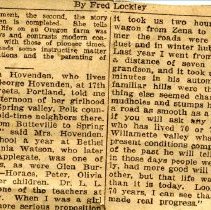
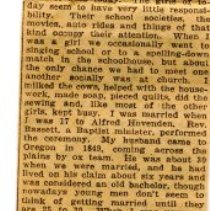
Copies: 1 ( 1 original newspaper clipping) "By Fred Lockley In this installment, the second, the story of Mrs. Hovenden is completed. She tells what a woman's life on an Oregon farm was in the earlier days and contrasts modern con- ditions in general with those of pioneer times. Mr. Lockley appends to some instructive matter relating to inventions and the patenting of them. --------- Sarah Soden Hovenden, who live with her son, George Hovenden, at 17th and Wasco streets, Portland, told me on a recent afternoon of her girlhood days, spent in Spring valley, Polk coun- ty, and of her old-time neighbors there. 'We moved from Butteville to Spring valley in 1853,' said Mrs. Hovenden. 'I went to school a year at Bethel academy, Virginia Watson, who later married Mr. Applegate, was one of my schoolmates, as were Glen Bur- nett's children -- Horace, Peter, Olivia and the younger children. Dr. L. L. Rowland was one of the teachers at Bethel academy. When I was a girl life seemed a more serious proposition than it does today. The girls of to- day seem to have very little responsi- bility. Their school socities, the movies, auto rides and things of that kind occupy their attention. When I was a girl we occassionally went to a singing school or to a spelling-down match in the schoolhouse, but about the only chance we had to meet one another socially was at church. I milked the cows, helped with the house- work, made soap, pieced quilts, did the sewing and, like most of the other girls, kept busy. I was married when I was 17 to Alfred Hovenden. Rev. Bassett, a Baptist minister, performed the ceremony. My husband came to Oreogn in 1849, coming across the plains by ox team. He was about 30 when we were married, and he had lived on his claim about six years and was considered an old bachelor, though nowadays yound men don't seem to think of getting married until they are 25 to 30. When I was young a girl was considered an old maid if she wasn't married in her teens, and most of the young men began thinking of marriage when they came of age. * * * 'My husband owned a half-section a mile west of Hubbard. Our neighbors were the Grimms, the Whitneys, the Demmicks, and the St. Johns. I lived on our place there 48 years. In the city the women have electric ranges, vacuum cleaners, stationary tubs and many other labor-saving conveniences, but in the country a wife, when I was a young woman, did the house- work by hand and no thought was ever given to making the work easier for her. To cook over the fireplace, get the water from the well, milk the cows, help with the chores, take care of the babies, do the churning, make the soap, mend socks and make clothes was part of the woman's contract when she got married. Another thing city women never have to do is to cook for harvest crews, to be up by 3:30 or 4 o'clock in the morning so the men can be out in the field by sunrise, and get supper for them at about 7:30 or 8 o'clock at night, and then do all the dishes and prepare the food for the next day. The city woman doesn't really know what hard work is. * * * 'I had four children, Caroline, my eldest daughter, married John Dennis. I attended her funeral last week. Emma married M.L. Jones of Brooks. Annie married Frank Gilbert, a banker at Salem, who died while undergoing an operation at New Haven some years ago. My son George is the baby. I have made my home with George an my daughter-in-law for some time. * * * 'I never expected to live as long as I have, and yet I have enjoyed life and I have enjoyed seeing life made easier for other women. During the past half century, I have seen woman emancipated, not alone in the way of voting but in the way of an entire change of attitude toward her. Today she is a helpmate and a comrade and has equal rights with her husband. * * * 'I have seen another thing. I hav e seen mankind released from the bond- age of bad roads. When I was a girl it took us two hours to travel by wagon from Zena to Salem. In sum- mer the roads were knee-deep with dust and in winter knee-deep with mud. Last year I went from Salem to Zena, a distance of seven miles, with my grandson, and it took us about 15 or 20 minutes in his automobile. The old familiar hills were there, but every- thing else seemed changed. The ruts, mudholes and stumps had given way to a road as smooth as a ribbon. I think if you will ask any Oregon pioneer who has lived 70 or 75 years in the Willamette valley what he thinks of of the past he will yell you this --- that in those days people were more friend- ly, had more good will toward one an- other, but that life was much harder than it is today. Looking back over 70 years, I can see that humanity has made real progress.'" (front of original) "April - 6 - 1923" (handwritten on back) |
Title |
Sarah Hovenden Second Installment of Life Story |
Collection |
Photograph Collection |
People |
Hovenden, Sarah (nee Soden) Applegate, Virginia (nee Watson) Applegate, Mr. [?] Burnett, Horace Burnett, Peter Burnett, Olivia Burnett, Glen Hovenden, Alfred Dennis, Caroline (nee Hovenden) Dennis, John Jones, Emma (nee Hovenden) Jones, Madison L. Gilbert, Annie (nee Hovenden) Gilbert, Frank Hovenden, George Lockley, Fred |